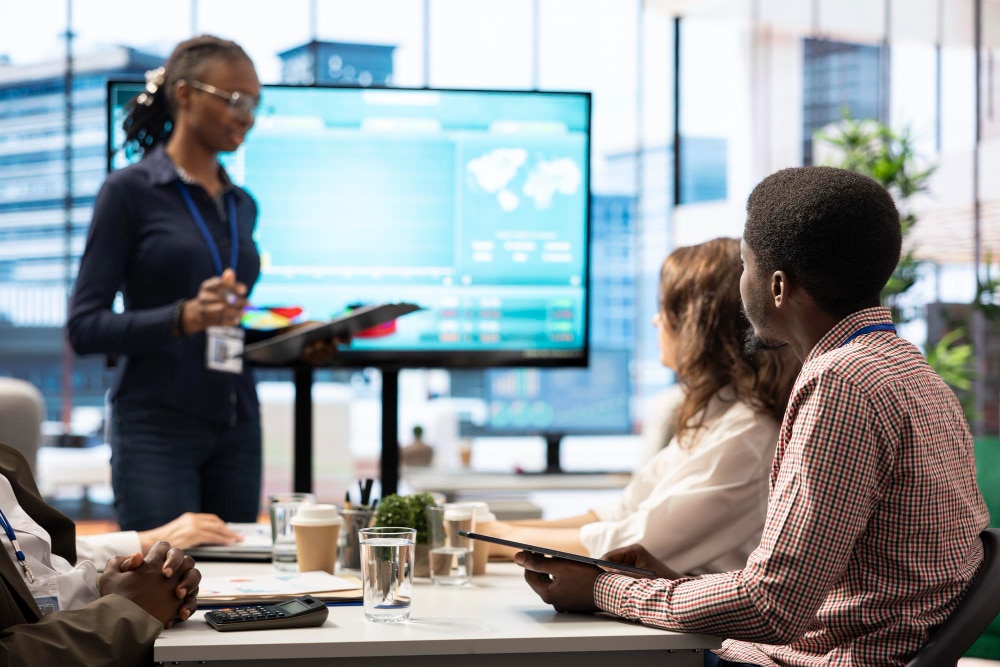
For years, the learning debate was binary: digital or in-person. Digital learning promised scale and flexibility. In-person sessions promised engagement and networking. But choosing one meant sacrificing the benefits of the other, often leading to compromised results. The answer isn’t an “or”—it’s a strategic “and.”
Modern blended learning models intentionally combine self-paced digital elements with live, human-guided experiences. The goal is not just to use different tools, but to use each tool for what it does best. This creates a learning journey that is more effective, more resilient, and more respectful of the modern learner’s time than any single method could be.
Think of it as constructing a house. You wouldn’t use only bricks or only glass. You use bricks for the solid foundation and walls, and glass for windows to bring in light. Similarly, you use e-learning for consistent knowledge transfer and foundational concepts, and live sessions for practice, discussion, and nuanced application. A true learning solutions provider architects these experiences deliberately, using evidence to guide the blend. Done well, this approach significantly boosts engagement, knowledge retention, and the likelihood of real-world skill application.
Effective blending is guided by cognitive science. It leverages two powerful principles: the “spacing effect” and the “testing effect.”
The spacing effect shows that we learn more effectively when exposure to information is spread out over time, not crammed into a single event. A blended learning model naturally creates spacing. Learners engage with content in modules over weeks, allowing time for mental processing and rehearsal between sessions.
The testing effect (or “retrieval practice”) proves that actively recalling information strengthens memory more than passive re-reading. Blended models incorporate frequent, low-stakes knowledge checks, quizzes, and application exercises—often in the digital components—to force this productive struggle. The live sessions can then focus on higher-order skills like analysis and creation.
Forget the old model of “watch these videos then come to a workshop.” Modern blends are more dynamic.
A pile of disconnected parts is not a blended learning model. The digital and live elements must feel like one cohesive experience. This requires a central hub, like a Learning Management System (LMS) or a team collaboration platform, where everything connects—the schedule, the content, the discussions, and the assignments.
Technology should make the journey seamless, not complicated. The best corporate learning solutions use technology to enable personalization, track progress across modalities, and foster community through discussion forums or social feeds that persist between live sessions.
At InQuest, we don’t default to a standard blend. Our research consultants analyze the specific performance goal, audience, and context. We ask: “What part of this skill is best learned alone? What part requires social interaction or expert coaching?” We then design the sequence, choose the tools, and create the content to fit that blueprint.
Our training services ensure the blend feels intentional, not piecemeal. We focus on the learner’s journey from start to finish, creating a logical, supportive path that guides them from knowledge to proven competence.
Blending is the strategic future of workplace learning. It respects the learner’s autonomy while providing the human support necessary for complex skill development.
Interested in a blended program that actually works? We architect blended learning models based on how people learn best. Explore our approach on our Learning Solutions page.